

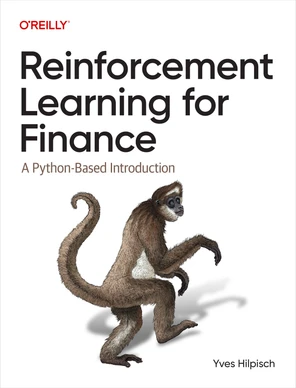
Book Reinforcement Learning for Finance
Reinforcement learning (RL) has led to several breakthroughs in AI. The use of the Q-learning (DQL) algorithm alone has helped people develop agents that play arcade games and board games at a superhuman level. More recently, RL, DQL, and similar methods have gained popularity in publications related to financial research. This book is among the first to explore the use of reinforcement learning methods in finance. Author Yves Hilpisch, founder and CEO of The Python Quants, provides the background you need in concise fashion. ML practitioners, financial traders, portfolio managers, strategists, and analysts will focus on the implementation of these algorithms in the form of self-contained Python code and the application to important financial problems. This book covers: * Reinforcement learning * Deep Q-learning * Python implementations of these algorithms * How to apply the algorithms to financial problems such as algorithmic trading, dynamic hedging, and dynamic asset allocation This book is the ideal reference on this topic. You'll read it once, change the examples according to your needs or ideas, and refer to it whenever you work with RL for finance. Dr. Yves Hilpisch is founder and CEO of The Python Quants, a group that focuses on the use of open source technologies for financial data science, AI, asset management, algorithmic trading, and computational finance.
Book preface
Before you start, a short look at what you will learn in this book
In the preface, settle the general questions you have at a glance, so your view widens and your choice is more informed. Questions such as: Why was this book written and what problem does it solve? Who can use the book? A summary of the chapters and the learning goals of each part? The important changes and new improvements added across editions, and so on — we cover all of these for you.
Target audience
Machine learning practitioners looking to expand into financial market applications.
Financial traders and quantitative analysts interested in implementing AI strategies.
Portfolio managers and strategists focusing on advanced asset allocation methods.
Developers wanting to build self-contained Python code for algorithmic trading.
Financial researchers investigating deep Q-learning algorithms and applications.
Professionals interested in data generation and generative adversarial networks.
Individuals seeking to develop automated trading and dynamic hedging agents.
Students and academics focusing on computational finance and data science.
Enthusiasts of open-source technologies applied to financial data science.
Traders wanting to construct reinforcement learning based hedging models.
Data analysts working extensively with financial time series datasets.
Market participants seeking modern portfolio optimization techniques.
Professionals aiming to leverage advanced artificial intelligence in capital markets.
Those looking for a practical programming reference using Python.
Researchers studying option pricing and replication models.
Readers wanting a comprehensive introduction to reinforcement learning in finance.
Why the book was written
This book represents one of the first comprehensive guides exploring reinforcement learning methods specifically in finance.
The author provides self-contained Python implementations that make complex algorithmic trading and hedging concepts accessible.
Readers gain foundational background information and advance toward sophisticated financial applications seamlessly.
The practical code examples allow practitioners to adapt scripts directly to their individual research projects.
The publication covers essential deep Q-learning concepts alongside advanced data generation approaches.
It details simulation techniques and generative adversarial networks to overcome data limitations in finance.
Common pitfalls and failing analogies when applying reinforcement learning to market data are thoroughly examined.
The structured format serves as an ideal ongoing reference manual for quantitative researchers.
The author shares professional expertise in open-source technologies for computational finance.
Content focuses heavily on real-world problems including algorithmic trading and dynamic asset allocation.
Readers learn how to construct and train custom trading and hedging agents from scratch.
This resource bridges the gap between advanced artificial intelligence theory and practical financial markets.
The text integrates modern artificial intelligence techniques with traditional financial analytics.
Using Python packages like Gymnasium facilitates experimental and interactive learning for readers.
Asset allocation strategies are implemented and evaluated against benchmark portfolios systematically.
This work stands as an invaluable reference for quantitative analysts and market participants.
Content overview
As one of the earliest guides, this book successfully adapts reinforcement learning concepts to finance.
The author's explanations regarding deep Q-learning algorithms are remarkably clear and practical.
The provided Python code enables readers to test theories directly in experimental environments.
This publication is essential for any financial practitioner exploring machine learning.
The comprehensive coverage of data simulation techniques and generative adversarial networks is invaluable.
Topics concerning algorithmic trading and option hedging are detailed step-by-step.
The structured format facilitates learning and serves as a permanent desk reference.
Yves Hilpisch once again demonstrates his expertise in computational finance.
The book adeptly examines the challenges of applying reinforcement learning to financial data.
Practical examples regarding asset allocation yield impressive and consistent performance results.
This work creates a superb bridge between financial theory and artificial intelligence algorithms.
Reading this title is strongly recommended for fintech researchers and developers.
The book's content is built upon fully self-contained and reproducible Python scripts.
It supplies the necessary tools for constructing custom trading and hedging agents.
The author's hands-on approach makes sophisticated concepts easily digestible.
This book sets a new standard in computational finance literature.
Published
Reading time
05:04
Book type
Subscription
Participants
1 readers
Last updated
Oct 14, 2026