

Book Reinforcement Learning for Finance
Reinforcement learning (RL) has led to several breakthroughs in AI. The use of the Q-learning (DQL) algorithm alone has helped people develop agents that play arcade games and board games at a superhuman level. More recently, RL, DQL, and similar methods have gained popularity in publications related to financial research. This book is among the first to explore the use of reinforcement learning methods in finance. Author Yves Hilpisch, founder and CEO of The Python Quants, provides the background you need in concise fashion. ML practitioners, financial traders, portfolio managers, strategists, and analysts will focus on the implementation of these algorithms in the form of self-contained Python code and the application to important financial problems. This book covers: * Reinforcement learning * Deep Q-learning * Python implementations of these algorithms * How to apply the algorithms to financial problems such as algorithmic trading, dynamic hedging, and dynamic asset allocation This book is the ideal reference on this topic. You'll read it once, change the examples according to your needs or ideas, and refer to it whenever you work with RL for finance. Dr. Yves Hilpisch is founder and CEO of The Python Quants, a group that focuses on the use of open source technologies for financial data science, AI, asset management, algorithmic trading, and computational finance.
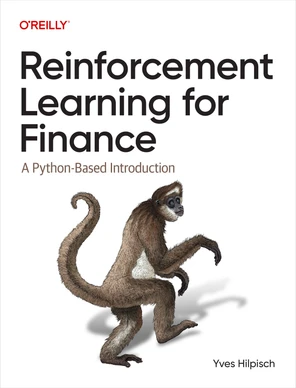
Book overview
A look at the structure and key facts of the book

Publication date
October 14, 2024

Edition
1 edition

Total chapters
10 chapters

Total pages
214 pages

Level
Intermediate to advanced

Reinforcement learning (RL) has led to several breakthroughs in AI. The use of the Q-learning (DQL) algorithm alone has helped people develop agents that play arcade games and board games at a superhuman level. More recently, RL, DQL, and similar methods have gained popularity in publications related to financial research.
This book is among the first to explore the use of reinforcement learning methods in finance.
Author Yves Hilpisch, founder and CEO of The Python Quants, provides the background you need in concise fashion. ML practitioners, financial traders, portfolio managers, strategists, and analysts will focus on the implementation of these algorithms in the form of self-contained Python code and the application to important financial problems.
This book covers:
- Reinforcement learning
- Deep Q-learning
- Python implementations of these algorithms
- How to apply the algorithms to financial problems such as algorithmic trading, dynamic hedging, and dynamic asset allocation
This book is the ideal reference on this topic. You'll read it once, change the examples according to your needs or ideas, and refer to it whenever you work with RL for finance.
Dr. Yves Hilpisch is founder and CEO of The Python Quants, a group that focuses on the use of open source technologies for financial data science, AI, asset management, algorithmic trading, and computational finance.
Browse this section to get a quick overall picture of the book's content.
The Basics and Reinforcement Learning
The first part of the book covers the basics of reinforcement learning and provides background information.
It consists of three chapters focusing on learning through interaction, dynamic programming, and financial Q-learning.
Readers explore major examples including probability matching, Bayesian updating, and deep Q-learning.
The chapters lay the foundational understanding required for applying advanced reinforcement learning algorithms to financial datasets.
Data Augmentation and Financial Applications
Subsequent parts cover data generation approaches and classical financial problem applications.
Techniques such as Monte Carlo simulation and generative adversarial networks are utilized to generate consistent financial time series data.
Algorithms are applied to algorithmic trading, dynamic hedging of options, and optimal asset allocation strategies.
Practitioners learn to implement self-contained Python code to solve real-world financial challenges.
The authors behind this book are among the most prominent experts and pioneers of their field. Their work is the result of years of hands-on experience, deep research and collaboration with the world's largest technology organizations and companies.Each of these authors, through specialist books and articles, has played an important role in shaping and advancing technical knowledge worldwide.

Comments
Readers' experience with this book - comments from buyers and other users
Published
Reading time
05:04
Book type
Subscription
Participants
1 readers
Last updated
Oct 14, 2026