

Book Security Chaos Engineering
Cybersecurity is broken. Year after year, attackers remain unchallenged and undeterred, while engineering teams feel pressure to design, build, and operate "secure" systems. Failure can't be prevented, mental models of systems are incomplete, and our digital world constantly evolves. How can we verify that our systems behave the way we expect? What can we do to improve our systems' resilience? In this comprehensive guide, authors Kelly Shortridge and Aaron Rinehart help you navigate the challenges of sustaining resilience in complex software systems by using the principles and practices of security chaos engineering. By preparing for adverse events, you can ensure they don't disrupt your ability to innovate, move quickly, and achieve your engineering and business goals. * Learn how to design a modern security program * Make informed decisions at each phase of software delivery to nurture resilience and adaptive capacity * Understand the complex systems dynamics upon which resilience outcomes depend * Navigate technical and organizational trade-offs that distort decision making in systems * Explore chaos experimentation to verify critical assumptions about software quality and security * Learn how major enterprises leverage security chaos engineering
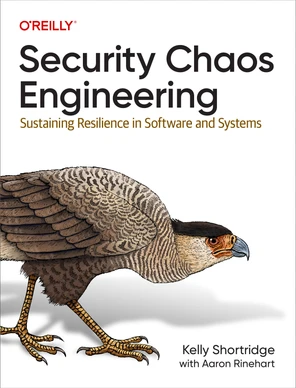
Book overview
A look at the structure and key facts of the book

Publication date
March 30, 2023

Edition
1 edition

Total chapters
9 chapters

Total pages
428 pages

Level
Intermediate to advanced

Cybersecurity is broken. Year after year, attackers remain unchallenged and undeterred, while engineering teams feel pressure to design, build, and operate "secure" systems. Failure can't be prevented, mental models of systems are incomplete, and our digital world constantly evolves. How can we verify that our systems behave the way we expect? What can we do to improve our systems' resilience?
In this comprehensive guide, authors Kelly Shortridge and Aaron Rinehart help you navigate the challenges of sustaining resilience in complex software systems by using the principles and practices of security chaos engineering. By preparing for adverse events, you can ensure they don't disrupt your ability to innovate, move quickly, and achieve your engineering and business goals.
- Learn how to design a modern security program
- Make informed decisions at each phase of software delivery to nurture resilience and adaptive capacity
- Understand the complex systems dynamics upon which resilience outcomes depend
- Navigate technical and organizational trade-offs that distort decision making in systems
- Explore chaos experimentation to verify critical assumptions about software quality and security
- Learn how major enterprises leverage security chaos engineering
Browse this section to get a quick overall picture of the book's content.
Resilience in Software Systems
This section delves into the concept of resilience in complex software systems. Resilience refers to a system's ability to maintain its critical functions when faced with disruptions and unexpected events. Understanding why complex systems are inherently unpredictable and how we can prepare for these uncertainties is key.
Key topics include the nature of complex systems, the types of stressors (acute and chronic), and how surprises emerge within these systems. It also distinguishes between robustness and resilience, and why attempting to prevent failure entirely is often impractical. This section emphasizes the importance of flexibility and embracing change to achieve true resilience.
Security Chaos Engineering (SCE)
This section introduces Security Chaos Engineering (SCE) as an approach to improving system resilience. By conducting controlled experiments to simulate adverse conditions, SCE helps identify weaknesses and flawed assumptions about system security and performance.
Key topics include developing mental models of systems, how attackers exploit these models, and methods for resilience testing. The section also explores the difference between "Fail-Safe" and "Safe-to-Fail" approaches, arguing that SCE offers a more comprehensive, system-centric perspective. The ultimate goal is to build systems that can withstand security events and recover quickly.
Designing and Architecting Resilient Systems
This section focuses on the principles of designing and architecting resilient systems. It examines how investments in system development impact resilience. The authors explore the four failure modes resulting from system design and the two key axes of resilient design: coupling and complexity.
Topics include the importance of designing to preserve possibilities, the dangers of tight coupling, and ways to invest in loose coupling in software systems. It also discusses understanding essential versus accidental complexity and how to introduce linearity into systems for better predictability and manageability. The goal is to design systems that can withstand disruptions and operate more effectively.
The authors behind this book are among the most prominent experts and pioneers of their field. Their work is the result of years of hands-on experience, deep research and collaboration with the world's largest technology organizations and companies.Each of these authors, through specialist books and articles, has played an important role in shaping and advancing technical knowledge worldwide.


Comments
Readers' experience with this book - comments from buyers and other users
9 chapters in production
Reading time
14:36
Book type
Subscription
Participants
Be the first
Last updated
Sep 30, 2026