

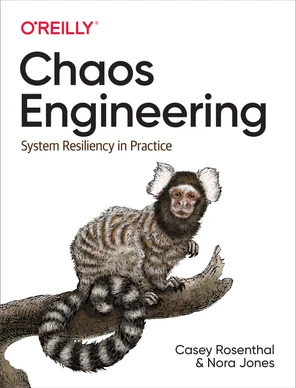
Book Chaos Engineering
As more companies move toward microservices and other distributed technologies, the complexity of these systems increases. You can't remove the complexity, but through Chaos Engineering you can discover vulnerabilities and prevent outages before they impact your customers. This practical guide shows engineers how to navigate complex systems while optimizing to meet business goals. Two of the field's prominent figures, Casey Rosenthal and Nora Jones, pioneered the discipline while working together at Netflix. In this book, they expound on the what, how, and why of Chaos Engineering while facilitating a conversation from practitioners across industries. Many chapters are written by contributing authors to widen the perspective across verticals within (and beyond) the software industry. Learn how Chaos Engineering enables your organization to navigate complexity Explore a methodology to avoid failures within your application, network, and infrastructure Move from theory to practice through real-world stories from industry experts at Google, Microsoft, Slack, and LinkedIn, among others Establish a framework for thinking about complexity within software systems Design a Chaos Engineering program around game days and move toward highly targeted, automated experiments Learn how to design continuous collaborative chaos experiments
Book overview
A look at the structure and key facts of the book

Publication date
April 6, 2020

Edition
1 edition

Total chapters
21 chapters

Total pages
305 pages

Level
Intermediate to advanced

As more companies move toward microservices and other distributed technologies, the complexity of these systems increases. You can't remove the complexity, but through Chaos Engineering you can discover vulnerabilities and prevent outages before they impact your customers. This practical guide shows engineers how to navigate complex systems while optimizing to meet business goals.
Two of the field's prominent figures, Casey Rosenthal and Nora Jones, pioneered the discipline while working together at Netflix. In this book, they expound on the what, how, and why of Chaos Engineering while facilitating a conversation from practitioners across industries. Many chapters are written by contributing authors to widen the perspective across verticals within (and beyond) the software industry.
- Learn how Chaos Engineering enables your organization to navigate complexity
- Explore a methodology to avoid failures within your application, network, and infrastructure
- Move from theory to practice through real-world stories from industry experts at Google, Microsoft, Slack, and LinkedIn, among others
- Establish a framework for thinking about complexity within software systems
- Design a Chaos Engineering program around game days and move toward highly targeted, automated experiments
- Learn how to design continuous collaborative chaos experiments
Browse this section to get a quick overall picture of the book's content.
Navigating Complexity in Distributed Systems
This book addresses the increasing complexity of modern distributed systems, such as microservices architectures. It provides engineers with a practical guide to understanding and managing this complexity, rather than attempting to eliminate it. The focus is on how Chaos Engineering serves as a proactive discipline to navigate these intricate environments effectively. By embracing complexity, organizations can build more resilient systems.
Proactive Vulnerability Discovery and Outage Prevention
A central tenet of Chaos Engineering is its ability to proactively identify vulnerabilities within systems. The book details methodologies for discovering weaknesses in application logic, network configurations, and underlying infrastructure. By intentionally introducing controlled failures, engineers can prevent larger outages and ensure system stability before customers are impacted. This approach shifts from reactive problem-solving to a preventative resilience strategy.
The authors behind this book are among the most prominent experts and pioneers of their field. Their work is the result of years of hands-on experience, deep research and collaboration with the world's largest technology organizations and companies.Each of these authors, through specialist books and articles, has played an important role in shaping and advancing technical knowledge worldwide.


Comments
Readers' experience with this book - comments from buyers and other users
Published
Reading time
08:45
Book type
Subscription
Participants
Be the first
Last updated
Nov 16, 2026