

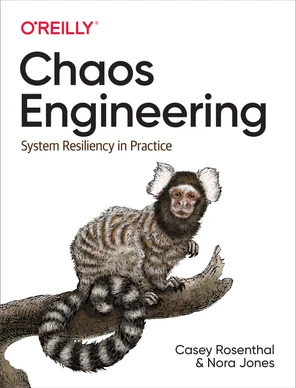
Book Chaos Engineering
As more companies move toward microservices and other distributed technologies, the complexity of these systems increases. You can't remove the complexity, but through Chaos Engineering you can discover vulnerabilities and prevent outages before they impact your customers. This practical guide shows engineers how to navigate complex systems while optimizing to meet business goals. Two of the field's prominent figures, Casey Rosenthal and Nora Jones, pioneered the discipline while working together at Netflix. In this book, they expound on the what, how, and why of Chaos Engineering while facilitating a conversation from practitioners across industries. Many chapters are written by contributing authors to widen the perspective across verticals within (and beyond) the software industry. Learn how Chaos Engineering enables your organization to navigate complexity Explore a methodology to avoid failures within your application, network, and infrastructure Move from theory to practice through real-world stories from industry experts at Google, Microsoft, Slack, and LinkedIn, among others Establish a framework for thinking about complexity within software systems Design a Chaos Engineering program around game days and move toward highly targeted, automated experiments Learn how to design continuous collaborative chaos experiments
Book preface
Before you start, a short look at what you will learn in this book
In the preface, settle the general questions you have at a glance, so your view widens and your choice is more informed. Questions such as: Why was this book written and what problem does it solve? Who can use the book? A summary of the chapters and the learning goals of each part? The important changes and new improvements added across editions, and so on — we cover all of these for you.
Target audience
Individuals responsible for the reliability, availability, and performance of complex distributed systems will find this book invaluable. It offers advanced techniques to proactively identify and mitigate system vulnerabilities.
Those involved in designing and implementing microservices or other distributed architectures will benefit from understanding how to build resilience into their systems from the outset. The book provides frameworks for thinking about system complexity.
Leaders looking to establish or mature a Chaos Engineering program within their organization will find practical guidance on implementation, team structure, and demonstrating ROI. It helps in fostering a proactive approach to system stability.
While primarily focused on software, the principles and case studies extend to anyone managing systems with many interacting parts. The book provides a foundational understanding of complexity and how to navigate it effectively.
Why the book was written
This book provides essential guidance for engineers grappling with the increasing complexity of modern distributed systems and microservices. It offers a structured approach to understanding and managing these intricate environments.
It serves as a critical resource for organizations aiming to prevent costly outages by proactively identifying system vulnerabilities. The methodologies presented help teams discover weaknesses before they impact customers.
The content is grounded in real-world experiences and case studies from leading tech companies like Netflix, Google, and Microsoft. This ensures that the advice and techniques are practical and proven in diverse industry settings.
By detailing how to design and automate chaos experiments, the book helps organizations build a culture where resilience is continuously tested and improved. It moves teams beyond reactive incident response to proactive system hardening.
Content overview
This book is lauded for its comprehensive exploration of Chaos Engineering, moving beyond theoretical concepts to practical, actionable strategies. It effectively demystifies the discipline, making it accessible to a wide range of engineering professionals.
Readers appreciate the diverse perspectives offered through contributions from experts across various industries, including Google, Microsoft, and Slack. This multi-faceted approach enriches the content with real-world applicability and varied implementation strategies.
The guide is highly valued for its emphasis on proactive resilience, teaching engineers how to identify and mitigate system vulnerabilities before they lead to customer-impacting outages. It provides a clear roadmap for building more robust and reliable distributed systems.
It is considered an authoritative resource, co-authored by pioneers of Chaos Engineering at Netflix, offering deep insights into the "what, how, and why" of the practice. The book successfully bridges the gap between understanding system complexity and effectively navigating it.
Published
Reading time
08:45
Book type
Subscription
Participants
Be the first
Last updated
Nov 16, 2026