

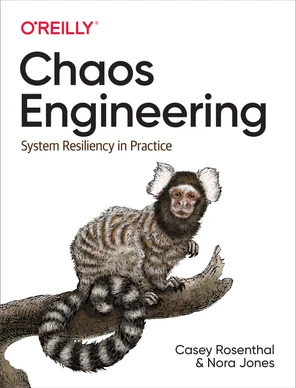
Book Chaos Engineering
As more companies move toward microservices and other distributed technologies, the complexity of these systems increases. You can't remove the complexity, but through Chaos Engineering you can discover vulnerabilities and prevent outages before they impact your customers. This practical guide shows engineers how to navigate complex systems while optimizing to meet business goals. Two of the field's prominent figures, Casey Rosenthal and Nora Jones, pioneered the discipline while working together at Netflix. In this book, they expound on the what, how, and why of Chaos Engineering while facilitating a conversation from practitioners across industries. Many chapters are written by contributing authors to widen the perspective across verticals within (and beyond) the software industry. Learn how Chaos Engineering enables your organization to navigate complexity Explore a methodology to avoid failures within your application, network, and infrastructure Move from theory to practice through real-world stories from industry experts at Google, Microsoft, Slack, and LinkedIn, among others Establish a framework for thinking about complexity within software systems Design a Chaos Engineering program around game days and move toward highly targeted, automated experiments Learn how to design continuous collaborative chaos experiments
Book chapters
Browse the chapters to quickly get to know the structure and content of the book.
By browsing the chapters of this book you can quickly see what each part teaches, how the whole is structured and where to start. Each chapter focuses on one concept or skill, and you see its main topics so your choice is more informed. Whether you follow the whole book or just one part, this view helps you find your way.
I. Setting the Stage
Throughout history, competitive advantages have presented themselves as complex systems. Military science, construction, maritime innovations—to the humans who had to interact with those systems at the time, there were so many moving parts interacting in unforeseeable ways that it was impossible to predict the result with confidence. Software systems are today’s complex systems.
Chaos Engineering was deliberately created as a proactive discipline to understand and navigate complex systems. Part I of this book introduces examples of complex systems and grounds the principles of Chaos Engineering within that context. The content of Chapter 1 and Chapter 2 is laid out in the natural order that experienced engineers and architects learn to manage complexity: contemplate, encounter, confront, embrace, and finally navigate it.
Chapter 1 explores the properties of complex systems, illustrating those properties with three examples taken from software systems: “In complex systems, we acknowledge that one person can’t hold all of the pieces in their head.” In Chapter 2 we turn our attention to navigating complexity as a systemic approach: “The holistic, systemic perspective of Chaos Engineering is one of the things that sets it apart from other practices.” Two models, the Dynamic Safety Model and the Economic Pillars of Complexity Model, are presented as ways to think about working with the complexity.
Chapter 3 builds on that exploration of complex systems presented ...
Encountering Complex Systems
Navigating Complex Systems
Overview of Principles
II. Principles in Action
We felt it was important to showcase different voices from different organizations throughout this book. There is no one-size-fits-all Chaos Engineering program. Some of the opinions and guidance presented herein are not entirely consistent, and that’s okay. We did not shy away from disagreement and opposing viewpoints. You will find common themes like building a “big red button” into chaos programs, as well as conflicting opinions like whether Chaos Engineering is a form of testing or experimentation.
We specifically chose perspectives from Slack, Google, Microsoft, LinkedIn, and Capital One. We bring forth the most compelling examples and narratives and we leave it to the reader to pick and choose which are most relevant to their own circumstances. In complex systems, context is king.
We begin with Chapter 4, “Slack’s Disasterpiece Theater” with Richard Crowley describing the particular approach to Chaos Engineering at Slack. With a combination of legacy and modern systems, Slack provides a target-rich environment for exploring different methods of Chaos Engineering. Richard chose to develop a unique approach to Game Days with particular flair: “Through more than twenty exercises it has discovered vulnerabilities, proven the safety of systems new and old, and affected the roadmaps of many engineering teams.”
Jason Cahoon takes us inside Google’s analog to Chaos Engineering, called “DiRT,” in Chapter 5, “Google DiRT: Disaster Recovery Testing.” ...
Slack’s Disasterpiece Theater
Google DiRT: Disaster Recovery Testing
Microsoft Variation and Prioritization of Experiments
LinkedIn Being Mindful of Members
Capital One Adoption and Evolution of Chaos Engineering
III. Human Factors
Resilience is created by people. The engineers who write the functionality, those who operate and maintain the system, and even the management that allocates resources toward it are all part of a complex system. We call this a sociotechnical system.
By the end of this part, we hope to convince you that successfully improving your resilience requires an understanding of the interplay between the human and nonhuman actors who authorize, fund, observe, build, operate, maintain, and make demands of the system. Chaos Engineering can help you better understand the sociotechnical boundary between the humans and the machines.
Nora Jones opens this part of the book with Chapter 9, “Creating Foresight.” With a focus on learning as a means of improving resilience, she explains how sometimes the most important part of Chaos Engineering happens before an experiment is even run. She also ties in the relationship between controlled experimentation and unplanned incidents: “Incidents are an opportunity for us to sit down and see how one person’s mental model of how the system worked is different than another person’s mental model of how the system worked.”
Andy Fleener explores the application of Chaos Engineering to the “socio” part of sociotechnical systems in Chapter 10, “Humanistic Chaos.” He asks, “What if we could apply the field of Chaos Engineering not only to the complex distributed technical systems we know and love, but to the complex distributed systems known ...
Creating Foresight
Humanistic Chaos
People in the Loop
The Experiment Selection Problem (and a Solution)
IV. Business Factors
Chaos Engineering exists to solve a real business need. It was born at Netflix and now has adoption across thousands of companies, a large portion of which are not primarily software companies. This part of the book provides more context about how Chaos Engineering fits into the larger context of business concerns.
Chapter 13, “ROI of Chaos Engineering,” addresses the most important question about the practice from a business perspective, namely: How do we prove that adopting Chaos Engineering provides more value than it costs? “Demonstrating the ROI of Chaos Engineering is not easy. In most cases, you will feel the value of experiments almost immediately, before you can articulate that value.” This chapter provides a model for considering ROI and applies it to the practice.
Russ Miles takes the business considerations in a different direction in Chapter 14, “Open Minds, Open Science, and Open Chaos,” by emphasizing the relationship between business domains and scientific pursuits. “Like all science, Chaos Engineering is at its most valuable when it is highly collaborative: where everyone can see what experiments are being pursued, when they are happening, and what findings have surfaced.” He makes a case for open source tools, experiments, and community to get the most value out of this discipline.
One of the most common questions for organizations adopting Chaos Engineering is where to start, or how to proceed. Chapter 15, “Chaos Maturity Model,” provides ...
ROI of Chaos Engineering
Open Minds, Open Science, and Open Chaos
Chaos Maturity Model
V. Evolution
By definition, a human cannot understand a complex system well enough to make accurate predictions about its output. Chaos Engineering certainly lives within a complex system of interacting practices, needs, and business environments. That said, clear trends have emerged that outline the future directions of this practice and its place within broader industry. This part of the book speaks to those trends.
The first chapter in this part of the book, Chapter 16, “Continuous Verification,” situates Chaos Engineering within a larger category of software practices. “Like CI/CD (continuous integration/continuous delivery), the practice is born out of a need to navigate increasingly complex systems. Organizations do not have the time or other resources to validate that the internal machinations of the system work as intended, so instead they verify that the output of the system is inline with expectations.” Many companies have already embraced the term “continuous verification” (CV) and interest is growing in the full complement of practices “CI/CD/CV,” particularly at companies that operate software systems at scale.
The following chapter, Chapter 17, “Let’s Get Cyber-Physical,” takes a half-step away from software into the realm of hardware with cyber-physical systems (CPSs). “It turns out that when you get a lot of highly experienced, cross-disciplinary people together over a long enough period of time to undertake an activity like [Failure Mode and Effects Analysis], ...
Continuous Verification
Let’s Get Cyber-Physical
HOP Meets Chaos Engineering
Chaos Engineering on a Database
The Case for Security Chaos Engineering
Conclusion
Published
Reading time
08:45
Book type
Subscription
Participants
Be the first
Last updated
Nov 16, 2026