

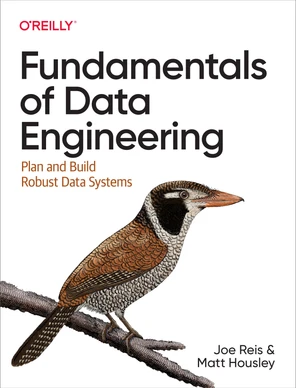
Book Fundamentals of Data Engineering
Data engineering has grown rapidly in the past decade, leaving many software engineers, data scientists, and analysts looking for a comprehensive view of this practice. With this practical book, you'll learn how to plan and build systems to serve the needs of your organization and customers by evaluating the best technologies available through the framework of the data engineering lifecycle. Authors Joe Reis and Matt Housley walk you through the data engineering lifecycle and show you how to stitch together a variety of cloud technologies to serve the needs of downstream data consumers. You'll understand how to apply the concepts of data generation, ingestion, orchestration, transformation, storage, and governance that are critical in any data environment regardless of the underlying technology. This book will help you: Get a concise overview of the entire data engineering landscape Assess data engineering problems using an end-to-end framework of best practices Cut through marketing hype when choosing data technologies, architecture, and processes Use the data engineering lifecycle to design and build a robust architecture Incorporate data governance and security across the data engineering lifecycle
Book preface
Before you start, a short look at what you will learn in this book
In the preface, settle the general questions you have at a glance, so your view widens and your choice is more informed. Questions such as: Why was this book written and what problem does it solve? Who can use the book? A summary of the chapters and the learning goals of each part? The important changes and new improvements added across editions, and so on — we cover all of these for you.
Target audience
Software engineers looking to transition into the data space will find this book highly valuable. It bridges the gap between traditional software practices and data-specific architectural patterns. It helps them apply their existing coding skills to complex data lifecycles.
Data scientists who need to understand the underlying infrastructure of their models will benefit greatly. It explains how data is ingested, stored, and prepared before it reaches analytical environments. This knowledge allows them to build more robust and deployable machine learning pipelines.
Data analysts wanting to expand their technical capabilities and understand data pipelines will find clear explanations. The book demystifies complex concepts like change data capture, orchestration, and transformation. It helps analysts communicate better with engineering teams and participate in architecture decisions.
Technical leaders and architects who need to design robust data platforms will find a comprehensive framework. It provides principles for building loosely coupled, scalable, and cost-effective systems. Leaders can use this guide to evaluate technologies and structure their data teams effectively.
Why the book was written
The rapid growth of the data industry has created a massive demand for structured learning. This book provides a clear, end-to-end framework to understand the entire data engineering landscape. It helps professionals move past individual tools to grasp core architectural concepts.
Choosing the right technology stack is incredibly challenging due to marketing hype. This book offers practical, unbiased advice to evaluate tools based on actual business value and total cost of ownership. It empowers teams to make reversible and cost-effective decisions.
Data security and governance are often treated as afterthoughts in fast-paced environments. This book integrates these critical undercurrents directly into every phase of the data lifecycle. It teaches readers how to build secure-by-design systems from the ground up.
Many practitioners struggle to collaborate effectively with upstream developers and downstream analysts. This book clarifies the roles and responsibilities of data engineers within an organization. It provides actionable advice on how to communicate and align with business leadership.
Content overview
This book serves as an essential, comprehensive guide to the modern data engineering landscape. It successfully shifts the focus from specific tools to enduring architectural principles. Readers appreciate its practical, real-world approach to complex system design.
The authors provide an invaluable framework for evaluating technologies without falling for marketing hype. It helps organizations save significant costs by focusing on total cost of ownership and FinOps. The structured breakdown of the data lifecycle is highly praised by industry professionals.
By integrating security, governance, and DataOps as continuous undercurrents, the book elevates standard engineering practices. It ensures that practitioners do not treat these critical aspects as mere afterthoughts. The clear explanations make complex topics accessible to a wide audience.
The real-world scenarios and collaborative insights make this book a must-read for cross-functional teams. It bridges the communication gap between technical engineers and business leadership. It is widely considered a foundational text for anyone entering or managing data teams.
11 chapters in production
Reading time
13:34
Book type
Subscription
Participants
Be the first
Last updated
Sep 30, 2026