

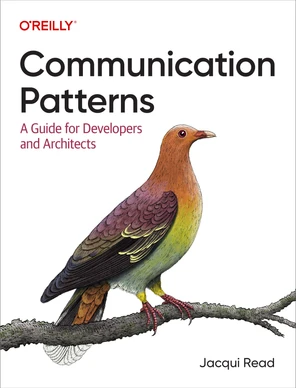
Book Communication Patterns
Having a great idea or design is not enough to make your software project succeed. If you want stakeholders to buy into your design and teams to collaborate and contribute to the vision, you also need to communicate effectively. In this practical book, author Jacqui Read shows you how to successfully present your architecture and get stakeholders to jump on board. Misunderstanding and lack of buy-in leads to increasing costs, unmet requirements, and an architecture that is not what you intended. Through constructive examples and patterns, this book shows you how to create documentation and diagrams that actually get the message across to the different audiences you'll face. This book shows you how to: Design diagrams and documentation appropriate to your expected audience, intended message, and project stage Create documentation and diagrams that are accessible to those with varying roles, needs, or disabilities Master written, verbal, and nonverbal communication to succeed in technical settings Apply the communication patterns presented in this book in real-world projects and software designs Communicate and collaborate with distributed teams to successfully design and document software and technical projects
Book chapters
Browse the chapters to quickly get to know the structure and content of the book.
By browsing the chapters of this book you can quickly see what each part teaches, how the whole is structured and where to start. Each chapter focuses on one concept or skill, and you see its main topics so your choice is more informed. Whether you follow the whole book or just one part, this view helps you find your way.
Visual Communication
Visual elements in software architecture and design communicate key information. Your audience’s eyes are naturally drawn to these elements, which may be the only thing they look at in any detail. Despite this, little guidance or training is available on creating diagrams and visuals (except notation-specific courses, such as ArchiMate), especially on how to effectively and successfully communicate your message to your audience.
Visual literacy, the ability to understand and create visuals, is a skill architecture and software training courses are missing. I wrote Part I to fill that knowledge gap. These patterns and antipatterns guide you to create diagrams that serve your audience’s needs and produce the outcomes you want. You will learn to strike a balance between the need for information and for accessibility.
For any diagram or visual you create, Part I offers many patterns that you can apply to successfully convey your message to your audience and get what you need in return.
Communication Essentials
Clarify the Clutter
Accessibility
Narrative
Notation
Composition
Multimodal Communication
Part II covers patterns, antipatterns, techniques, and frameworks for written, verbal (spoken), and nonverbal communication. Whether you work remotely, in an office, or a mixture of the two, you use all these types of communication regularly. Putting some extra thought into how you write, speak, and use body language and other nonverbal communication will make your message more understandable and increase your chances of receiving your desired response.
The sections within the chapters in Part II are organized as collections of patterns and antipatterns. You can apply the patterns for written communication to whatever you write, including emails, documentation, and instant messages. The verbal and nonverbal techniques can be applied whether you are talking to someone (or a group) face-to-face or remotely.
Chapter 9, the final chapter in this part, contains patterns and techniques for using rhetoric, which you can apply to all types of communication. Originally developed by Aristotle over two millennia ago, you might not think rhetoric would apply to communication in the modern technical world, but the techniques of ethos, pathos, and logos have stood the test of time for a good reason.
Apply all these patterns and techniques to strengthen your message, whatever format (or multiple formats) it takes.
Written Communication
Verbal and Nonverbal Communication
The Rhetoric Triangle
Communicating Knowledge
Most people think that knowledge management in organizations and technical teams means documentation, but that is only part of what you need to communicate knowledge. Your team and organization’s collective knowledge, including knowledge about your product or project, must be managed and guided to remain up-to-date, available, and accessible to the right people.
In Part III, you will learn the overarching principles of good knowledge development and management. Properly capturing and maintaining knowledge, and leveraging people, will enable you to get the best return on your investment in knowledge and documentation.
Chapter 10 will take you through some high-level patterns and principles to enhance your knowledge management and documentation. Chapter 11 gives you patterns and techniques to leverage people to improve knowledge development and management. Chapter 12 has patterns and methods for making the architecture practices that you use for knowledge management more effective so that you aren’t just going through the motions without reaping the benefits.
Apply the patterns, principles, and practices in Part III to your team, department, and organization to optimize your collective knowledge and improve productivity and innovation.
Knowledge Management Principles
Knowledge and People
Effective Practices
Communicating Remotely
Many modern teams are distributed in nature, either fully remote or hybrid, and can be spread across the globe. Creating software products in this environment requires different communication patterns than for a group of people sharing the same room and whiteboard. Whether you are communicating with colleagues, customers, or other businesses, you need to consider many factors, including time, work patterns, culture, inclusivity, and the channels you use to communicate.
Distributed communication has advantages and disadvantages compared to in-person. You can exploit or mitigate these to get the best outcomes for your teams and organization by applying the patterns and techniques presented in Part IV.
Before you dive in, I want to define synchronous and asynchronous communication, which are covered in depth throughout the following chapters:
- Asynchronous communication does not assume or expect the recipient to pick up or respond to the message as soon as it is received. This type of communication usually completes within hours or days, as opposed to seconds or minutes.
- Synchronous communication relies on all parties being available at the same time and responding in real time. This type of communication completes within seconds or minutes.
Remote Time
Remote Principles
Remote Channels
15 chapters in production
Reading time
07:53
Book type
Subscription
Participants
Be the first
Last updated
Sep 30, 2026