

Book Deciphering Data Architectures
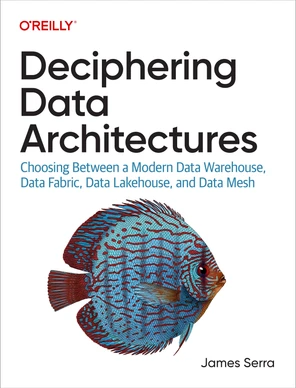
Data fabric, data lakehouse, and data mesh have recently appeared as viable alternatives to the modern data warehouse. These new architectures have solid benefits, but they're also surrounded by a lot of hyperbole and confusion. This practical book provides a guided tour of these architectures to help data professionals understand the pros and cons of each. James Serra, big data and data warehousing solution architect at Microsoft, examines common data architecture concepts, including how data warehouses have had to evolve to work with data lake features. You'll learn what data lakehouses can help you achieve, as well as how to distinguish data mesh hype from reality. Best of all, you'll be able to determine the most appropriate data architecture for your needs. With this book, you'll: Gain a working understanding of several data architectures Learn the strengths and weaknesses of each approach Distinguish data architecture theory from reality Pick the best architecture for your use case Understand the differences between data warehouses and data lakes Learn common data architecture concepts to help you build better solutions Explore the historical evolution and characteristics of data architectures Learn essentials of running an architecture design session, team organization, and project success factors Free from product discussions, this book will serve as a timeless resource for years to come.
Book chapters
Browse the chapters to quickly get to know the structure and content of the book.
By browsing the chapters of this book you can quickly see what each part teaches, how the whole is structured and where to start. Each chapter focuses on one concept or skill, and you see its main topics so your choice is more informed. Whether you follow the whole book or just one part, this view helps you find your way.
I. Foundation
In Part I of this book, I will lay the foundation for deciphering data architectures. Chapter 1 starts with a description of big data, while Chapter 2 provides an overview of the types of data architectures and their evolution. Chapter 3 shows how you can conduct an architecture design session to help determine the best data architecture to use for your project.
This part of the book will give you a good starting point to understand the value of big data and the history of the architectures that captured that data. The later chapters will then dig into the details.
Big Data
Types of Data Architectures
The Architecture Design Session
II. Common Data Architecture Concepts
Before diving into data architectures, it’s important to make sure you understand all the data architecture concepts that could be used within an architecture. I find there tends to be a lot of confusion about many of these concepts, which I hope to clear up. Therefore, you will find discussion of over 20 such concepts in the upcoming chapters. At the very least, these chapters will be a refresher for those who may have not used these concepts in a while. I don’t claim that all my definitions of these concepts are universally agreed upon by everyone, but at least these chapters will help get everyone on the same page to make it easier to discuss architectures.
I have included the relational data warehouse and the data lake under concepts instead of architectures. At one time, when they were the only products used in a solution, they could have been considered data architectures. Now, however, they are almost always combined with other products to form the solution. For example, many years ago there were relational data warehouse products that included the relational storage, compute, ETL (extract, transform, and load) software, and reporting software—basically everything you needed bundled together from one vendor. Nowadays, you will stitch together multiple products from possibly multiple vendors, with each product having a particular focus (e.g., ETL), to complete your data architecture.
The Relational Data Warehouse
Data Lake
Data Storage Solutions and Processes
Approaches to Design
Approaches to Data Modeling
Approaches to Data Ingestion
III. Data Architectures
Now that you have a good understanding of the data architecture concepts, it’s time to get into the meat of the book. The five chapters of Part III cover four architectures, in order of when they first appeared: the modern data warehouse, data fabric, data lakehouse, and data mesh.
These are my interpretations of the data architectures; others may have different opinions. In the end, your solution may even be a combination of these architectures.
The Modern Data Warehouse
Data Fabric
Data Lakehouse
Data Mesh Foundation
Should You Adopt Data Mesh? Myths, Concerns, and the Future
IV. People, Processes, and Technology
Congratulations! You have gotten through the foundational sections, the common data architecture concepts, and the four data architectures. But you’re not done yet. Chapter 15 covers the biggest determining factors in the success of whatever solution you build: people and processes. Chapter 16 covers data architecture technologies. To ensure that it stays relevant for many years to come, this discussion takes a vendor-neutral, historical, and high-level perspective.
People and Processes
Technologies
16 chapters in production
Reading time
07:29
Book type
Subscription
Participants
Be the first
Last updated
Sep 30, 2026