

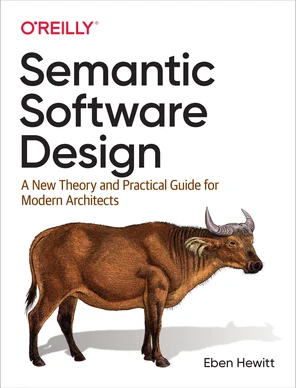
Book Semantic Software Design
With this practical book, architects, CTOs, and CIOs will learn a set of patterns for the practice of architecture, including analysis, documentation, and communication. Author Eben Hewitt shows you how to create holistic and thoughtful technology plans, communicate them clearly, lead people toward the vision, and become a great architect or Chief Architect. This book covers each key aspect of architecture comprehensively, including how to incorporate business architecture, information architecture, data architecture, application (software) architecture together to have the best chance for the system’s success. * Get a practical set of proven architecture practices focused on shipping great products using architecture * Learn how architecture works effectively with development teams, management, and product management teams through the value chain * Find updated special coverage on machine learning architecture * Get usable templates to start incorporating into your teams immediately * Incorporate business architecture, information architecture, data architecture, and application (software) architecture together
Book chapters
Browse the chapters to quickly get to know the structure and content of the book.
By browsing the chapters of this book you can quickly see what each part teaches, how the whole is structured and where to start. Each chapter focuses on one concept or skill, and you see its main topics so your choice is more informed. Whether you follow the whole book or just one part, this view helps you find your way.
Episteme: The Philosophy of Design
In this part, we explore the figure of design itself. We examine in new light how our work designing software came to be shaped, and challenge some received views in our industry. We reimagine architecture as the work of creating concepts, and see how to express those concepts working with teams to create effective software designs.
Origins of Software Architecture
The Production of Concepts
Deconstruction and Design
Semantic Design in Practice
In software, architects have frequently dithered away their time classifying existing systems, often in arbitrary or irrelevant ways. We, as semantic designers, produce concepts, challenged by deconstruction, in order to make a meaningful difference in our organizations, to take action to create a new world of possibilities.
In this part, we explore the “ground” of action, and refine the archetypal concepts introduced in Part I into the material realm. It’s filled with templates and practical guides to help you get your job done.
Design Thinking
Semantic Design Practices and Artifacts
The Business Aspect
The Application Aspect
The Data Aspect
The Infrastructure Aspect
Operations, Process, and Management
In Part III, we explore your role as semantic designer within an organizational context. You are the technology Creative Director. After you have interpreted and translated the theory into practice using the templates and guides provided, you need to get your project and systems up and running. It also must be managed appropriately after you’ve accomplished that. Here, we explore some best practices for governing and managing your work operationally. It’s filled with templates and practical guides to help you get your job done.
Finally, we close with a manifesto to capture in summary the main tenets of semantic software design.
The Creative Director
Management, Governance, Operations
The Semantic Design Manifesto
12 chapters in production
Reading time
09:33
Book type
Subscription
Participants
Be the first
Last updated
Sep 30, 2026